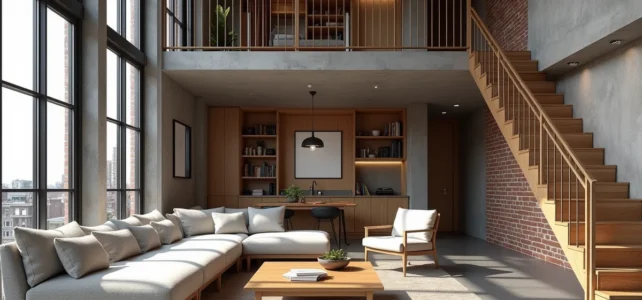
A duplex apartment refers to a dwelling organized over two levels connected by a private internal staircase. This configuration, often confused with a simple floor apartment, involves technical and regulatory particularities that we detail here for informed buyers and investors.
Thermal performance of new duplexes under RE2020
The two-level configuration generates thermal constraints absent in a single-level apartment. The staircase creates a thermal chimney effect between the two levels, with losses exacerbated by the void. Developers must over-insulate the roof and ensure airtightness around this void to achieve an A or B label on the energy performance certificate (DPE).
Since the implementation of RE2020, new duplexes are subject to the same energy performance and carbon footprint thresholds as other residential properties. Thermal bridges between levels remain a recurring weak point. In renovations, this issue is even more pronounced: a duplex created by combining two units in an older building often accumulates non-homogeneous walls and windows from different eras.
We recommend systematically checking the air tightness test report on a new duplex. A compliant result on a single-level T3 does not predict the behavior of a duplex of equivalent area, precisely because of the void.
To fully understand the definition of a duplex apartment and its variants (upward, downward, inverted), it is essential to integrate these technical constraints from the property search phase.

Duplex in elevation: planning permission and processing times
Creating a duplex by elevating an existing building faces regulatory tightening in major metropolitan areas. Paris and Lyon have seen an increase in refusals or requests for modifications to permits when a project involves elevation or the opening of large skylights on the roof.
The reasons cited by planning services focus on two axes:
- The preservation of urban silhouettes, with stricter height regulations in protected areas or those covered by a heritage local urban plan (PLU)
- The fight against overheating on the top floor, which now requires sunlight and summer comfort studies before processing
- The structural compatibility of the existing building, verified by a concrete or frame engineering firm depending on the age of the building
We observe that processing times for this type of project regularly exceed those of a standard permit. Anticipating additional processing time has become the norm for rooftop duplex projects.
Space organization and actual living area of a duplex
The main appeal of the duplex lies in the physical separation between day and night spaces. The lower level typically houses the living room, kitchen, and a bathroom. The upper floor contains the bedrooms and the main bathroom. This vertical distribution mimics the functioning of a single-family home while retaining the advantages of co-ownership.
The internal staircase consumes between one and several square meters per level. This footprint, often underestimated during visits, significantly reduces the usable area compared to a single-level apartment advertised at the same Carrez area. In a compact duplex, the staircase can represent a considerable portion of the total area.
Ceiling height and Carrez law
Parts of the duplex located under a sloping roof (common on the top floor) only count towards the Carrez area if the ceiling height exceeds 1.80 m. A duplex advertised with a large area may therefore conceal non-counted zones but presented as habitable in commercial plans.
We recommend requesting the surface area measurement conducted by a diagnostician and comparing it to the developer’s or seller’s plan. Discrepancies in duplexes under the eaves are common.
Acoustics and noise disturbances in a duplex
A well-designed duplex drastically reduces disturbances between neighbors. The dwelling shares only one party floor with another unit (below or above, depending on the configuration), compared to two in a classic mid-level apartment. This reduction in the number of party walls mechanically decreases exposure to impact and airborne noise.
The point of caution concerns the acoustic insulation of the internal staircase itself. In an older duplex, a wooden staircase not decoupled from the floor transmits vibrations between the two levels of the dwelling. Replacing it with a staircase on a metal structure with anti-vibration fixings significantly improves comfort.
Sound transmission through the void
The open void between the two levels acts as an acoustic conduit. Conversations or the television from the living room rise directly to the bedrooms. Solutions exist: landing door at the top of the staircase, sound-absorbing treatment of the walls of the staircase shaft, or partial partitioning of the void.
Without acoustic treatment of the void, the duplex loses the intimacy advantage it is supposed to provide compared to a single-level apartment.
Duplex and rental investment: the criteria that matter
In the rental market, the duplex attracts families or young professionals sharing accommodation. The separation of levels facilitates cohabitation and justifies a higher rent than that of a comparable standard apartment.
- The gross rental yield strongly depends on the location: in a dense city center, the rarity of the duplex gives it a premium on rent
- Rental vacancy remains generally low for this type of atypical property, provided that the staircase is not a hindrance for the targeted tenant profile (elderly, reduced mobility)
- Resale benefits from a niche market: duplexes negotiate with a lower discount during downturns than standard apartments, thanks to their rarity
The main risk remains the mismatch between the advertised area and the area actually usable. A poorly arranged duplex, with a steep staircase or too low eaves, loses its competitive advantage and finds itself in direct competition with standard T3 or T4 apartments, cheaper per square meter.
The choice of a duplex relies on a technical as well as aesthetic arbitration. Thermal insulation of the void, verified Carrez area, acoustic treatment of the staircase: these points, rarely addressed in listings, condition the actual value of the property in the long term.