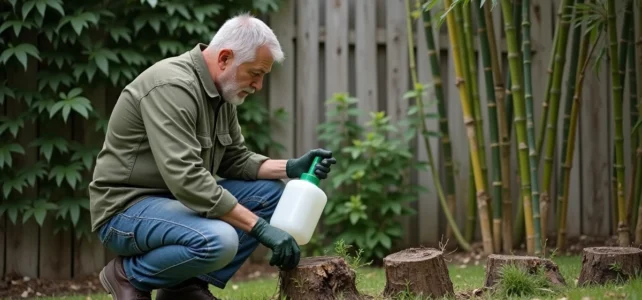
A running bamboo that overflows into the neighbor’s yard, rhizomes lifting a terrace, shoots breaking through gravel: this situation is familiar to many gardeners. Faced with the urgency, pouring bleach into the cut canes seems tempting. The product is accessible, inexpensive, and its reputation as a “plant killer” sticks to it. The reality on the ground tells a completely different story.
Bleach and running bamboo rhizomes: why the product doesn’t penetrate deep enough
To understand the failure of bleach, one must visualize what happens underground. A running bamboo of the Phyllostachys genus does not operate like a weed with a taproot. Its network of rhizomes extends horizontally, sometimes over several meters, and each node can produce a new shoot.
When you pour concentrated bleach into a cut cane, the product burns the surface tissues without reaching the active rhizomes. Sodium hypochlorite quickly decomposes upon contact with the organic matter in the soil. It loses its oxidizing power before it can reach the living parts of the underground network.
In practice, the treated cane turns black and appears dead. A few weeks later, new shoots emerge at a distance, nourished by intact portions of rhizome. For those who still wish to get rid of bamboo with bleach, feedback on specialized forums converges: regrowth systematically appears, sometimes several meters from the treatment point.
Soil damage and amateur gardening regulations
The failure against bamboo would be almost anecdotal if bleach didn’t damage everything else. Sodium hypochlorite destroys the microbial life of the soil: bacteria, mycorrhizal fungi, earthworms. These organisms ensure the decomposition of organic matter and the availability of nutrients for neighboring plants.
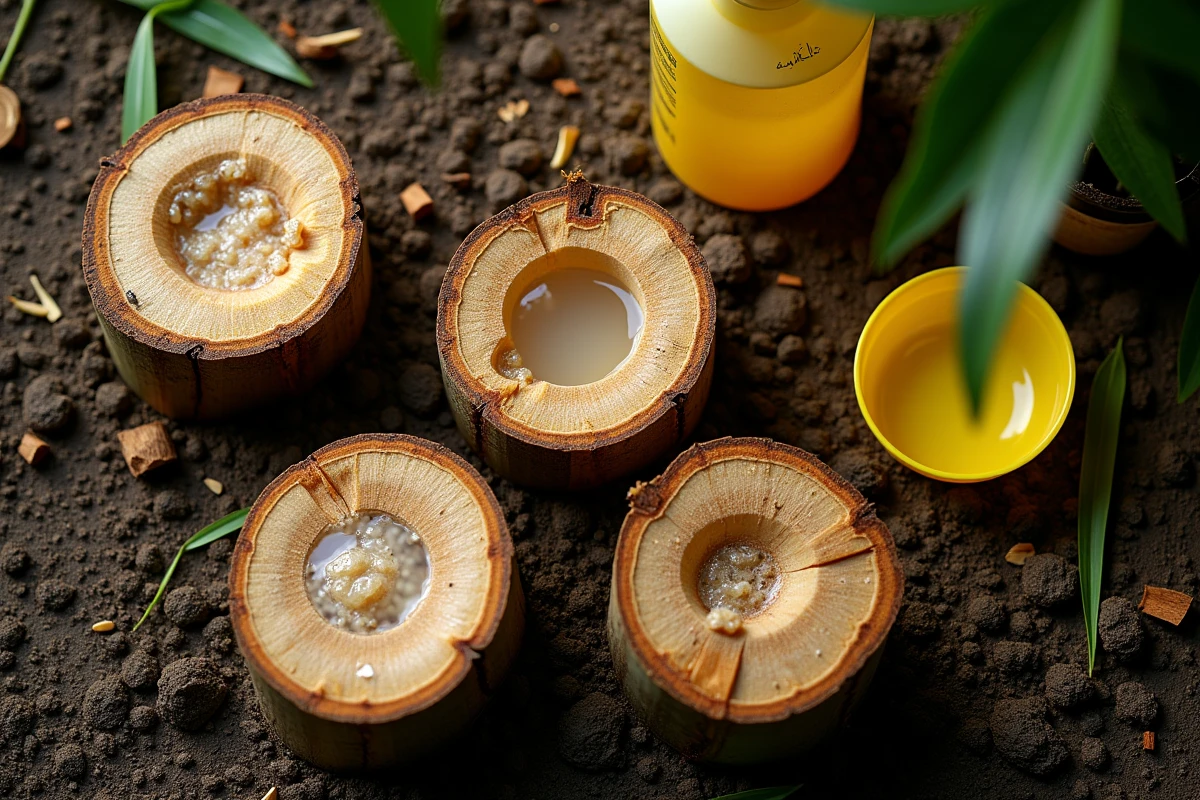
A soil treated with bleach becomes locally sterile. If you plan to replant after removing the bamboo, you will start with depleted soil that will take time to regain its fertility.
On the regulatory side, the situation has evolved. The Labbé law and the Ecophyto plan strictly regulate the use of toxic substances in amateur gardening. The use of biocides like bleach in open soil goes against this regulation, even though the product remains available for domestic uses. Several local authorities explicitly remind users of this incompatibility in their good practice guides.
Mechanical methods against invasive bamboo: what really works
Have you ever noticed that regularly cut bamboo loses vigor over the seasons? This is the principle of exhaustion through the suppression of photosynthesis, and it is the basis for any successful elimination.
Ground-level cutting and removal of regrowth
The first step is to cut all canes flush with the ground. Every new shoot that appears must be removed as soon as it emerges. This regular monitoring must last at least two to three years to exhaust the rhizome’s reserves.
It’s not spectacular, but it’s remarkably effective. A rhizome deprived of aerial parts can no longer produce energy through photosynthesis. It draws on its reserves until it is completely exhausted.
Opaque tarp to accelerate exhaustion
To save time, cover the cut area with a thick opaque tarp. The total lack of light prevents the shoots from developing and accelerates the death of the underground network. Be sure to extend well beyond the visible area of the bamboo, as the rhizomes extend beyond the last canes.
Mechanical removal of rhizomes
When the infested area is too large, mechanical removal becomes the quickest solution. Landscaping companies use mini-excavators to extract the rhizomes deeply. This method is particularly recommended when the rhizomes threaten built structures.
Home insurance companies are increasingly taking seriously the damage caused by running bamboos: lifted slabs, cracked walls, damaged pipes. Mechanical removal remains the only method that limits the risk of recurrence in the medium term over large areas.
Anti-rhizome barrier: prevent rather than cure
Why this topic in an article about elimination? Because the majority of infested gardens could have been protected from the outset. If you keep some of your bamboos or if a neighbor has some, the anti-rhizome barrier is the only reliable preventive measure.
Here are the criteria to check for effective installation:
- A high-density polyethylene (HDPE) material, thick enough to withstand the pressure of the rhizomes over time
- A burial depth of at least 60 centimeters, as Phyllostachys rhizomes primarily circulate in the upper soil horizons
- A few centimeters protruding above ground level, to prevent the rhizomes from passing over
- An annual check of the perimeter, especially at the junctions between barrier sections
Without this precaution, even after complete removal, a forgotten rhizome fragment with a few nodes is enough to restart a colonization.
Bleach, coarse salt, vinegar: the common point of false solutions
Bleach is not the only “trick” circulating. Coarse salt and white vinegar are regularly recommended on social media. Their common point: they act on the surface, degrade the soil, and never reach the rhizomes.
- Coarse salt salinizes the soil and makes the area unsuitable for any cultivation for a long time
- White vinegar burns the leaves but has no systemic effect on the root network
- Bleach destroys the soil fauna without affecting the vigor of the deep rhizomes
These products give the illusion of a result because the visible parts turn yellow or black. Underground, the bamboo continues its expansion quietly.
For a garden permanently rid of its running bamboos, the combination of ground-level cutting, systematic removal of regrowth, and opaque tarp remains the most accessible method. For significant invasions with a risk of structural damage, the intervention of a professional equipped with a mini-excavator avoids years of uncertain struggle.