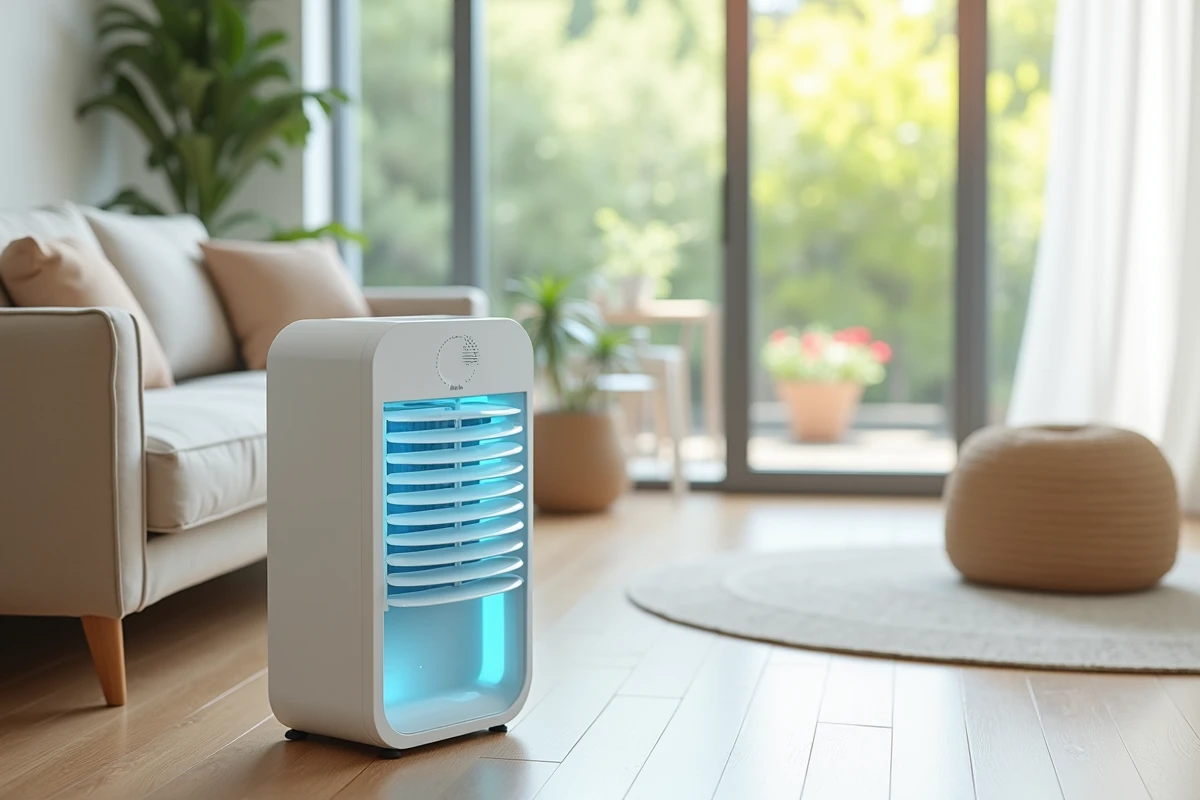
Installing an air cooler in an attic room in the middle of July, without an exhaust duct or any renovations: this is the typical use case for the OneConcept Caribbean Blue. This 3-in-1 model (fan, humidifier, cooler) is positioned in the cheapest segment of the market. We took a close look at what it actually offers, its real limitations, and the situations where it lives up to its promises.
Noise and speeds of the OneConcept Caribbean Blue: how it performs at night
Most online reviews mention the noise at high speed but quickly gloss over the topic. We focus on it because for many buyers, a cooler is primarily used for sleeping well when it’s hot.
The device offers three speeds. At speed 1, the airflow remains discreet and comparable to a desk fan. At speed 2, the noise level increases noticeably. At speed 3, the noise becomes bothersome for nighttime use in a small room. Feedback varies on this point depending on the distance between the device and the bed, but at less than two meters, the maximum speed may disturb light sleepers.
For daytime use in a living room or office, this drawback takes a back seat. However, if you are looking for a quiet device for the night, speed 1 remains the only viable option, which reduces the airflow and thus the feeling of coolness.
You can find the detailed specifications with efficiency ratings and ease of use on the OneConcept Caribbean Blue on rafraichisseurdair.com, which gives a decent overall rating to this entry-level model.

Tank and ice packs: actual autonomy in heatwave conditions
The Caribbean Blue features a removable tank of a few liters, accessible from the back of the device. Two ice packs included with the product are placed in the tray to lower the temperature of the blown air.
The cooling effect lasts about one to two hours with the ice packs, as they melt. After that, the device continues to blow humidified air, but the perceived temperature drop decreases significantly. To extend the effect, you need to have additional ice packs rotating in the freezer.
An easy-to-fill tank, but needs monitoring
The tray can be removed without tools, making filling and especially cleaning easier. One point not to overlook: stagnant water in a cooler’s tank promotes the growth of bacteria if not emptied regularly. Rinsing the tray every two or three days is a good habit, especially when the device runs daily during hot weather.
Air cooler in a humid home: the trap to know
The operating principle of the Caribbean Blue relies on the evaporation of water. Warm, dry air passes through a wet filter, and the temperature drops by a few degrees. The key word here is “dry”.
UFC-Que Choisir reminds us in its buying guide that in already humid homes, a cooler can make the atmosphere heavier and uncomfortable. This is not a flaw specific to the Caribbean Blue, but a physical limitation of evaporative technology. Specifically, a ground-floor apartment facing north with a high ambient humidity level is not the right context for this type of device.
For the cooler to function properly, the room must also be ventilated regularly. Without air renewal, the ambient humidity rises, and the cooling effect disappears. This leads to the paradox: opening the window when it’s hot outside cancels out some of the benefit.
Where the Caribbean Blue works well
- Dry and ventilated rooms (converted attics, high floors facing south or west)
- Occasional use during heat spikes, not as a permanent cooling system
- Small areas where proximity to the device compensates for the small temperature difference
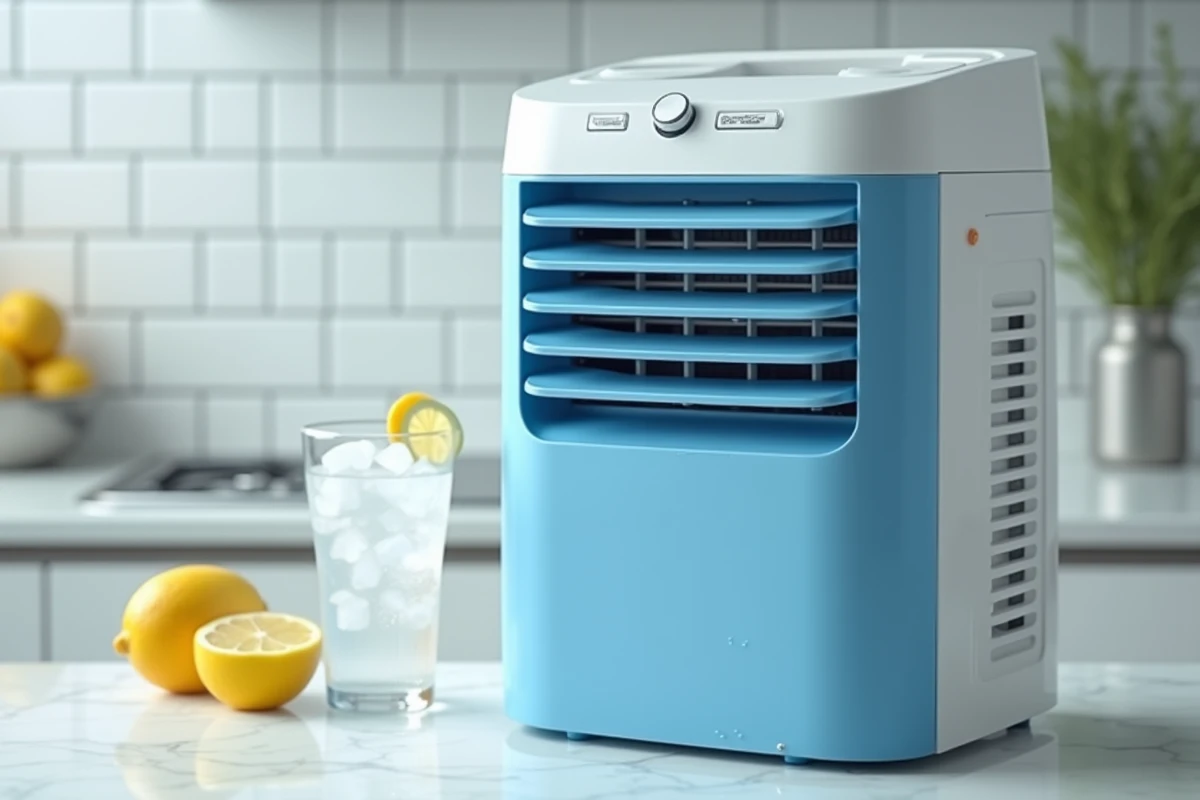
OneConcept Caribbean Blue compared to current models: is the price-quality ratio still defensible?
The Caribbean Blue was tested and marketed around 2017. Since then, the air cooler market has evolved. Brands like Klarstein (which belongs to the same group as OneConcept) now offer models with larger tanks, quieter night modes, and sometimes a remote control.
The Caribbean Blue remains the cheapest model in its category, and this is its main selling point. Its modest electricity consumption makes it a credible alternative to portable air conditioners for small budgets. At purchase, the price difference with a portable air conditioner is significant.
However, it is essential to keep in mind the structural limitations:
- An air cooler does not replace an air conditioner: the temperature drop remains only a few degrees
- The device humidifies the air, which can be a disadvantage depending on the home
- The announced airflow is adequate for an entry-level model, but recent models offer a better noise/performance compromise
Transport and daily bulk
The four wheels provided attach to the bottom of the device and facilitate moving it from one room to another. The side handles also allow for easy lifting. For a studio or a one-bedroom apartment, this mobile format is suitable: it can be moved from the living room to the bedroom at night.
The design remains simple and discreet, which is not always the case with coolers in this price range. The device does not stand out in an interior.
The Caribbean Blue fulfills its role for supplementary use in a dry home during periods of moderate heat. Expecting it to cool an entire apartment during a prolonged heatwave is asking a low-cost device to deliver what it has never promised. For a tight budget and calibrated expectations, it remains a coherent choice, as long as you do not confuse a cooler with an air conditioner.