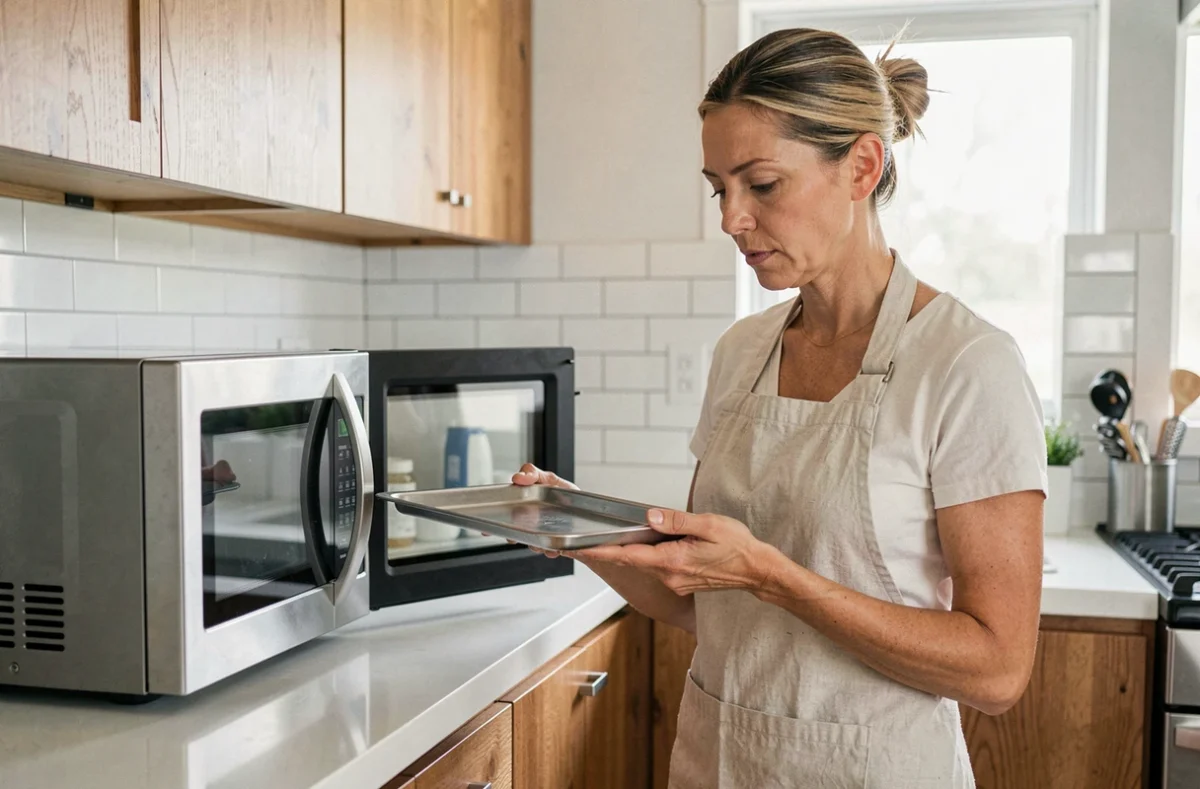
Aluminum reflects microwaves instead of allowing them to pass through. This physical behavior has given rise to a persistent belief: placing an aluminum tray in a microwave would systematically cause sparks or even a fire. The technical reality is more nuanced, and a French standard now regulates this practice.
Microwaves and Metal: The Physical Mechanism That Changes Everything
A microwave oven emits electromagnetic waves that agitate the water molecules contained in food. Metal, on the other hand, reflects these waves. In an open tray, the waves enter from the top and heat the food through its exposed surface. The aluminum bottom and walls reflect energy back to the food, resulting in surprisingly even heating.
The problem arises when the electric field concentrates at a specific point on the metal. Sharp edges, folds, tears, or points create areas of high electric density. This is where electric arcs are born, those visible sparks that are rightly concerning.
In other words, it is not the aluminum as a material that poses a problem, but its geometry and condition. A smooth, intact tray with rounded edges behaves very differently from a crumpled sheet thrown into the cavity.
There is also a common confusion with so-called “susceptor” packaging. These films, which have a thin metallic layer, are designed to concentrate heat and brown certain prepared dishes. Their presence in packaging does not mean that an ordinary aluminum tray in the microwave offers the same guarantees: they are two distinct technical products.
NF D21-314 Standard: The French Regulatory Framework for Trays
Published in January 2023 in the AFNOR collection, the NF D21-314 standard describes a method for assessing the suitability for microwave reheating of metallic or partially metallic articles in contact with foodstuffs. It covers bare or coated containers, whether single-use or reusable.
Specifically, this standard imposes tests under real conditions: measuring the temperature of the food, detecting electric arcs, and verifying the absence of abnormal migration of substances into the food. A tray compliant with this standard has therefore undergone a rigorous protocol before being declared microwave-safe.
The standard supports the transition to reusable metal containers by removing the main psychological barrier: the fear of metal in the microwave.
Safe Usage Conditions: What Causes (or Prevents) Sparks
Complying with the standard does not exempt one from precautions during reheating. The usage conditions determine safety as much as the design of the tray itself.
- The tray must be open or partially uncovered. A fully closed metal container blocks the waves and prevents proper heating of the food, in addition to promoting uneven heating.
- The surface must remain smooth and intact. Any deformation, tear, or raised edge concentrates the electric field and increases the risk of an arc.
- The tray should be placed in the center of the turntable, away from the walls of the cavity. This distance reduces interactions between the metal and the internal walls of the oven, which are also metallic.
- Only one metal container at a time. Stacking two trays or placing several side by side multiplies the reflective surfaces and areas of electric field concentration.
The Often Ignored Role of the Oven Manual
Compatibility also depends on the specific model of microwave. Some manufacturers exceptionally allow metal containers under strict conditions, while others formally prohibit them in microwave mode only (excluding grill or combined mode). The manufacturer’s instructions take precedence over any general rule.
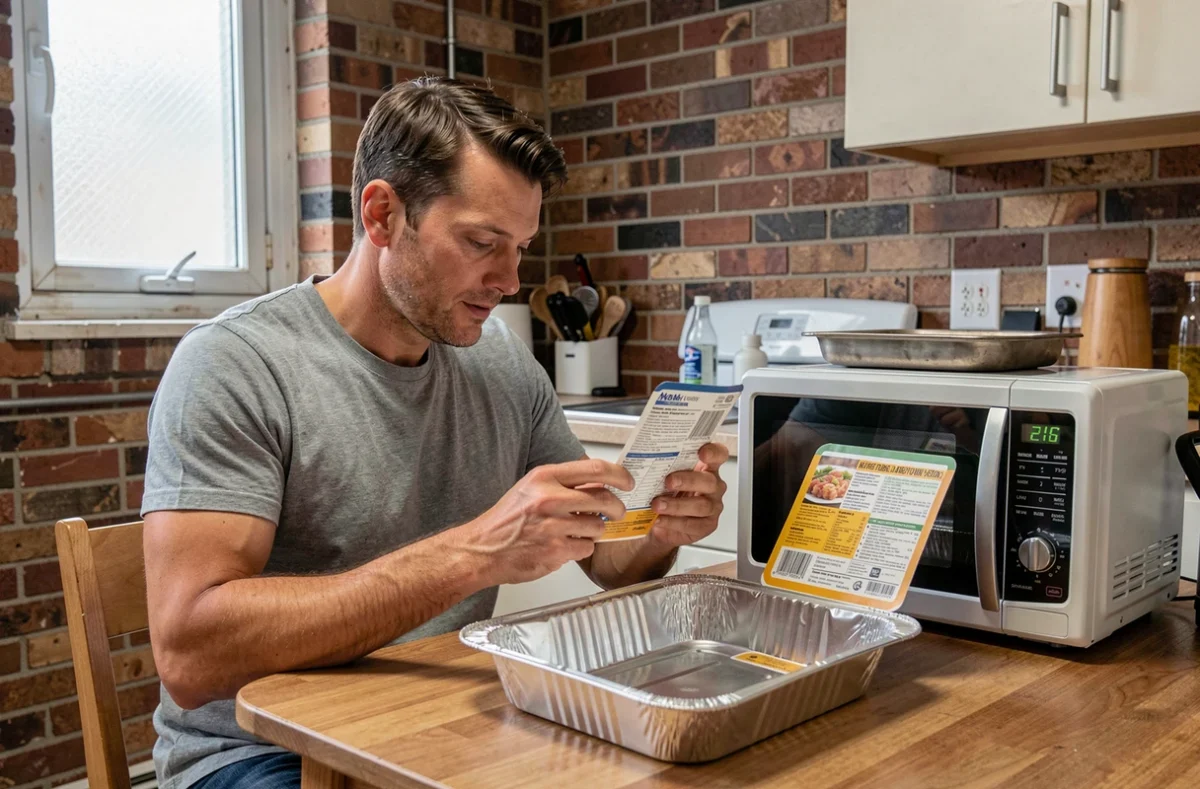
Before reheating a dish in its tray, checking the oven manual takes a minute. Ignoring this step amounts to assuming that all devices behave the same way, which is false.
Aluminum Tray and Reheating: Concrete Mistakes to Avoid
Most reported incidents do not come from properly used certified trays, but from inappropriate reflex actions.
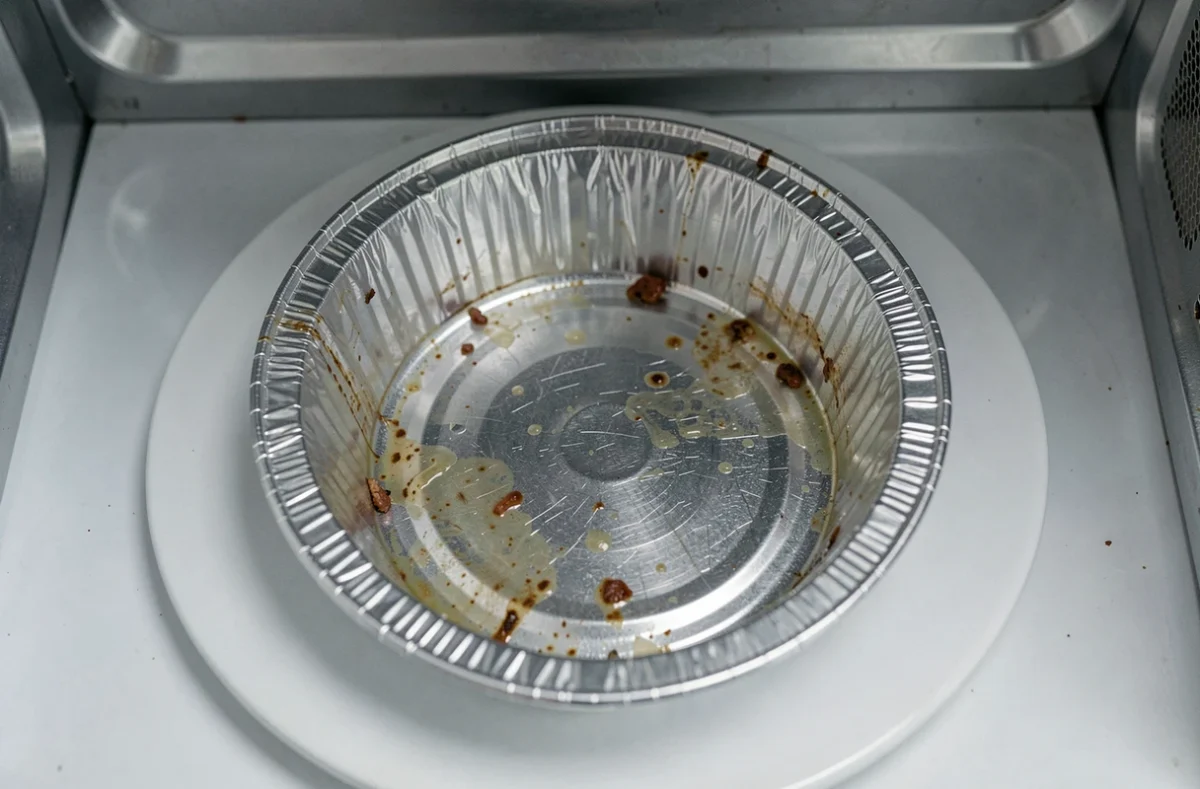
First mistake: reusing a tray that has already been deformed after its first use. The folds created during handling form exactly the type of edges that generate arcs. A tray that has been used to transport a delivered dish and shows dents or raised corners should not go in the microwave.
Second mistake: covering the food with crumpled aluminum foil to “keep the heat.” This foil, with irregular edges and multiple folds, accumulates all the risk factors. If a cover is necessary, a ceramic plate or suitable food film serves this purpose safely.
Third mistake: confusing microwave mode with combined mode (microwave + convection). In combined mode, the heating element and ventilation alter the thermal distribution. The recommendations of the NF D21-314 standard apply to microwave mode only, not to hybrid modes.
Aluminum, Plastic, Glass: Which Container to Reheat in the Microwave
The choice of reheating container is not limited to the issue of metal. Borosilicate glass (like Pyrex) and ceramic without metallic decoration remain the most universally compatible materials. They allow waves to pass through without reflecting or absorbing them.
- Plastic poses a different problem: some polymers release undesirable substances when heated, even at moderate temperatures. Only plastics bearing a microwave pictogram offer a guarantee.
- Certified NF D21-314 aluminum is a validated option for reheating, with the precautions described above.
- Non-certified stainless steel for microwaves should be avoided: its geometry (handles, rivets, protruding edges) multiplies the points of electric field concentration.
Reheating an aluminum tray in the microwave is neither a trivial reflex nor a forbidden action. The NF D21-314 standard has established a clear technical framework, but this framework relies on two checks that everyone can perform: the compliance of the tray and the compatibility of the oven. Without these two checks, the risk of electric arc remains real.